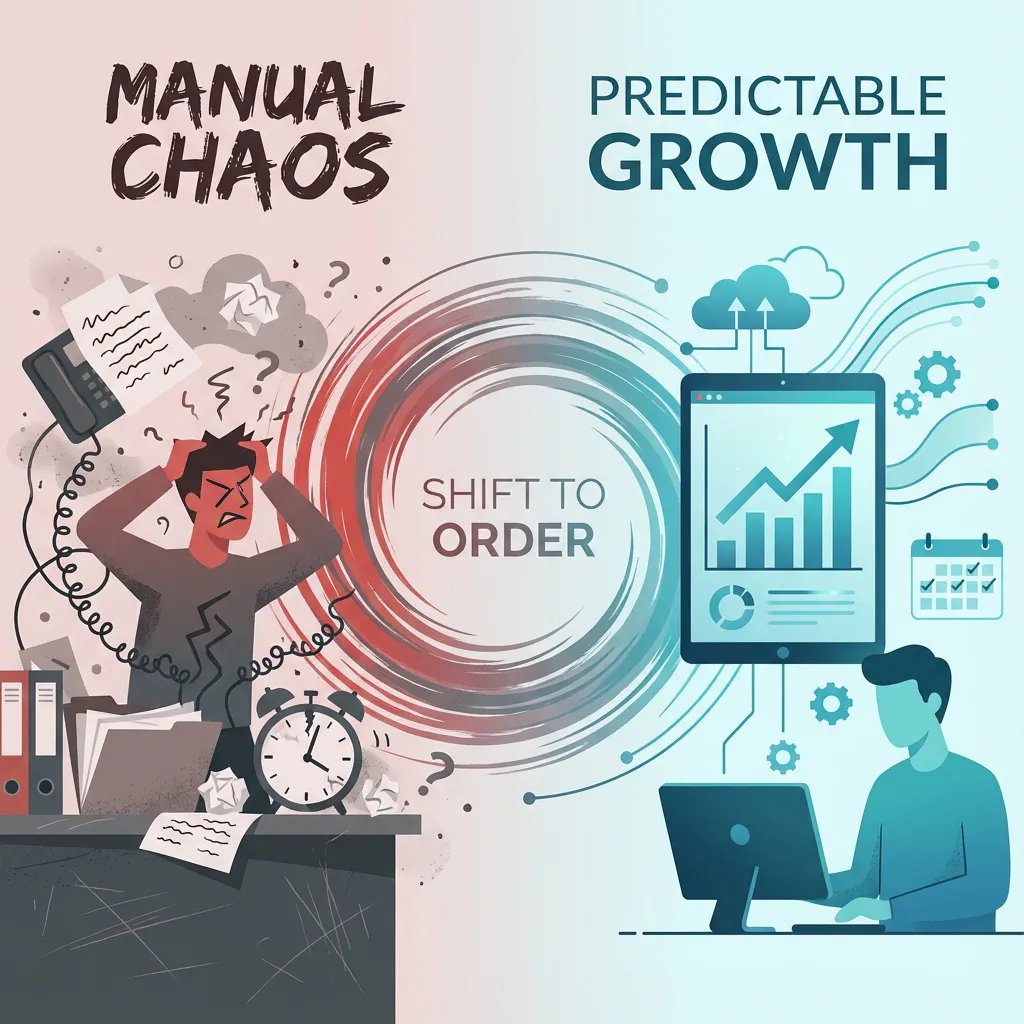
Most brands don’t start out chaotic. They get that way as channels multiply. What looks like hustle — the founder answering DMs at 11pm, staff tallying orders by hand, screenshots flying between packer and manager — is usually manual chaos wearing a nicer word. It works until it quietly becomes the thing holding you back.
What manual chaos actually looks like
WhatsApp as the “system.” Orders come in as chat messages, staff note down items and amounts, payments get confirmed by screenshot. It feels flexible. But one missed message is one lost order, and there’s no way to search what happened last Tuesday.
Stock as guesswork. Inventory lives on shelves, in a marketplace panel, in a spreadsheet that’s updated when someone remembers, and in a staff member’s head. The result is overselling, cancellations, and dead stock nobody spotted.
Mornings lost to sorting. With no single order queue, the day starts by gathering orders from scattered places, writing dispatch lists by hand, and verifying COD one call at a time.
Billing on patchwork. Different invoice formats online and in-store, B2B invoices typed by hand, tax handled differently by whoever’s free — so you never get one clean view of revenue.
The cost of staying manual
It’s not just annoying; it’s expensive. Missed orders and slow fulfilment cost you repeat buyers, because trust online is built on speed and consistency. You end up hiring more people to do coordination that a system should do, with senior staff stuck on basic admin. And you make decisions on opinion instead of data, because no one can reliably say which products actually make money or where the margin leaks.
The shift: Order → Efficiency → Scale
The brands that grow steadily follow the same order of operations.
1. Order — create one source of truth. Give every product a proper SKU with clean variants and standard pricing. Put inventory in one place with real-time visibility across locations. Land every order — store, marketplace, WhatsApp, walk-in — in a single system. This is the foundation; nothing else works without it.
2. Efficiency — let the system do the repetitive work. Once the truth is in one place, automate around it: orders route themselves, pick lists generate, customers get status updates, and COD verification stops being a manual bottleneck. Billing uses the same product names and GST rules everywhere, and payments across UPI, cards and wallets reconcile against orders automatically.
3. Scale — grow without breaking. Now expansion is calm. A new outlet plugs into the same catalogue and stock. A new channel shows the same prices and availability. And because everything runs on one system, you can finally see your bestsellers by region, your dead SKUs, and your repeat-purchase patterns — and plan instead of react.
Before and after
Before, WhatsApp is your order system, Excel is your inventory, the POS is an island, and every busy day feels like a crisis. After, one catalogue serves every channel, one inventory count is always right, every order sits in one place, and a surge of orders is a good day — not a scramble.
The advantage that separates brands isn’t just the product. It’s whether “Order → Efficiency → Scale” is built into how the business runs. If you’re still holding it together with chat threads and spreadsheets, the move to one system is the one that makes growth predictable instead of painful.
Frequently asked
Isn't manual order handling just part of running a small brand?
At the start, yes — and it can feel personal and flexible. The problem is it doesn't scale: one missed WhatsApp message is one lost order, and past a few hundred orders a month the manual approach caps your growth no matter how hard the team works.
What does 'Order → Efficiency → Scale' actually mean?
It's a sequence. First create one source of truth for catalogue, stock and orders (Order). Then let the system do the repetitive work — routing, billing, reconciliation (Efficiency). Only then does adding stores, channels and volume become smooth instead of chaotic (Scale).
Where should a brand start?
With the foundation: a structured catalogue with proper SKUs, one live inventory count across locations, and every order — website, marketplace, WhatsApp, counter — landing in one place. Optimisation comes after the truth is in one system.